|
Home
|
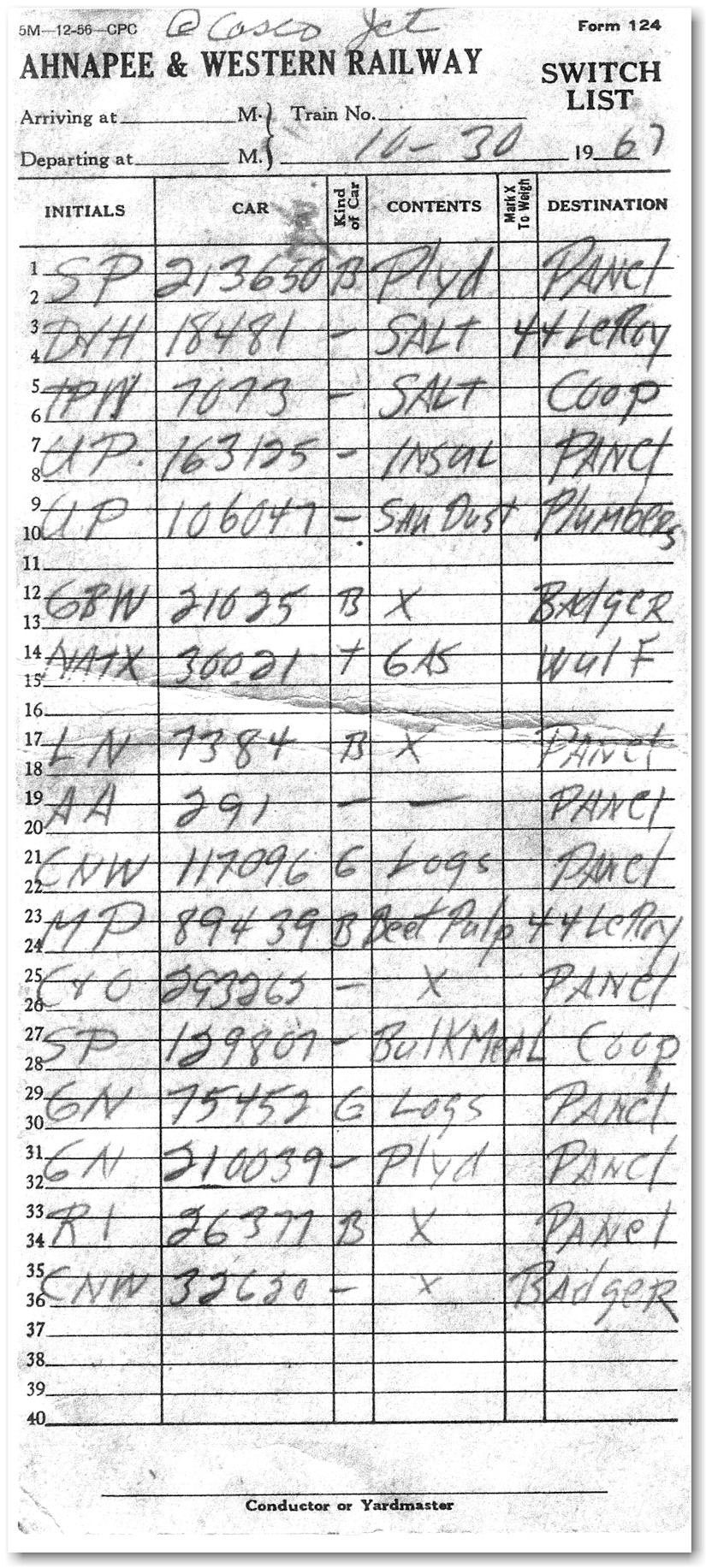
This switch list shows the cars, loads, and destinations of freight cars picked up at the Ahnapee & Western's interchange with the Green Bay & Western on Monday October 30, 1967.

The Ahnapee & Western's three-man crew normally went on duty around 3 p.m. and they would head to Casco Junction to pick up cars set out by Green Bay & Western trains. The interchange at Casco Junction was A&W's only connection to the rest of the North American rail network so all inbound freight came through this point.
When the A&W crew arrived at Casco Junction they would set out any cars to be interchanged with the GB&W and then pick up the incoming cut of cars on the interchange track. A&W conductor Jim Roubal would get the waybills of the incoming cars from a specially designated box and then prepared the switch list for the day's work. He would walk the length of the train -- starting from the caboose end -- writing up the switch list and inspecting the brakes of each car as he progressed to the front. Thus, the switch list has the caboose end of the train at the top.
When Jim got to the head of the train he would give any necessary instructions to engineer Francis Reynard, then the train would slowly pull forward and Jim would hop on the caboose as it went by.
The scale house at Casco Junction had a telephone which the A&W crew could use to call the GB&W dispatcher if needed. Although It was probably most often used for sending orders for empties and a breakdown of cars needing pickup by the GB&W trains, Jim said that one time he used it to call for permission to use the GB&W mainline to run around their train after they 'painted themselves into a corner' doing switching at Casco Junction!
Here's the A&W's switch list for Monday, October 30, 1967. It is from the collection of Thorval Franson, with comments supplied by Andy Laurent.
| Initials | Car | Kind of Car | Contents | Destination | Comments |
Image |
|
| SP | 213650 | B | PLYD | PANEL |
|
||
| D&H | 18481 | - | SALT | 44 LEROY |
|
||
| TPW | 7073 | - | SALT | COOP | Next was a 40-foot Toledo, Peoria & Western boxcar. It also was loaded with salt, but this load was for the Door County Cooperative feed mill on the west side of Sturgeon Bay. Salt was a common delivery to feed mills; it was used to supplement the diets of cattle and also sold to homeowners to treat the hard water which comes from wells in the limestone bedrock of the Door peninsula. | ||
| UP | 163125 | - | INSUL | PANEL | A 50-foot Union Pacific double-door boxcar had a load of insulation for the U.S. Plywood plant in Algoma. | ||
| UP | 106047 | - | SAW DUST | PLUMBERS | Plumbers Woodwork Company made "Badger Brand" toilet seats from pressed wood flour & sawdust. A 40-foot Union Pacific single-door boxcar was bringing in a load of sawdust for the plant located on a spur just west of Silver Creek in Algoma. | ||
| GBW | 21025 | B | X | BADGER |
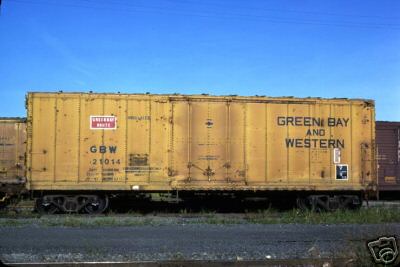
The sole Green Bay & Western Car in the train was an empty insulated boxcar for Badger Foods (formerly Reynolds Brothers Canning) in Sawyer. |
||
| NATX | 30021 | T | GAS | WULF | Next was a tank of liquid propane for Wulf Propane, located at the far south end of the siding on the west side of Sturgeon Bay. | ||
| LN | 7384 | B | X | PANEL |
|
||
| AA | 291 | - | - | PANEL |
|
||
| CNW | 117096 | G | LOGS | PANEL |
|
||
| MP | 89439 | B | BEET PULP | 44 LEROY |
A boxcar of beet pulp, a byproduct of the manufacture of table sugar and used as cattle feed, was heading to the Leroy Feed Mill via the team track in Forestville. |
||
| C&O | 293265 | - | X | PANEL | A Chesapeake and Ohio offset double-door boxcar (originally a Pere Marquette boxcar used for auto traffic) was being sent empty to the U.S. Plywood plant for loading. | ||
| SP | 129807 | - | BULK MEAL | COOP |
|
||
| GN | 75452 | G | LOGS | PANEL | A Great Northern gondola was the second load of logs heading to the U.S. Plywood plant on this day. | ||
| GN | 210039 | - | PLYD | PANEL |
The largest freight car in the train was a Great Northern 60-foot boxcar loaded with plywood, again for the U.S. Plywood plant in Algoma. |
||
| RI | 26377 | B | X | PANEL | An empty Rock Island boxcar was en route to the U.S. Plywood plant for loading. | ||
| CNW | 32620 | - | X | BADGER |
Finally, an empty Chicago & North Western 50-foot boxcar was heading to Badger Foods in Sawyer. This car was the closest to the locomotive. |
||