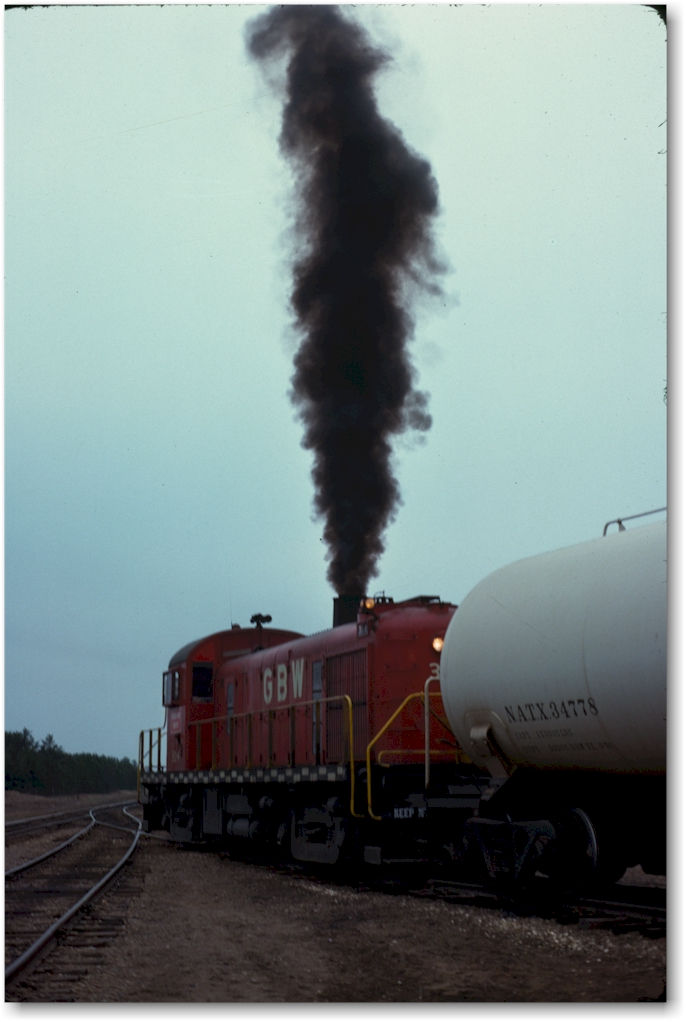
RS-2 #304 shoots a plume of Alco 'turbo lag' smoke into the Plover sky.
Bill Christopher caught this Alco working in Plover in the Spring of 1976. This is only a few months before #304 was retired and scrapped.
|
Classification Lights: |
|
|
Bob
Welke had this to say about the classification lights on the GBW RS-2s
and RS-3s: "On the GBW I have seen the white extra lights lit, but about the only time I've ever seen the others used was around Christmas time as 'decorations'. "Now here's a question for you
timetable and train order modelers: What classification light color do you
display on the engine of an extra with a second section following? White,
green or both white and green?" |
|
|
Plover, April 1976 |
|
 Plover Plume |
|
Large plumes of black smoke were a hallmark of Alco's turbocharged '244' and '251' engines. The smoke was a by-product of the phenomenon of turbo lag: When the engine was fed more fuel to accelerate, the fuel-air mixture became overly rich until the turbine compressing the air got up to a corresponding speed. The rich fuel-air mixture caused the heavy black smoke. Later engines had more sophisticated controls to eliminate turbo lag.
The GB&W RS-2s were operated with the long hood as the "forward" end of the engine for their entire duration on the railroad. This engine is displaying white classification lights at the end of the long hood, indicating an extra train.
Bill Christopher photo,
April, 1976.
This photo may not be reproduced without permission.
